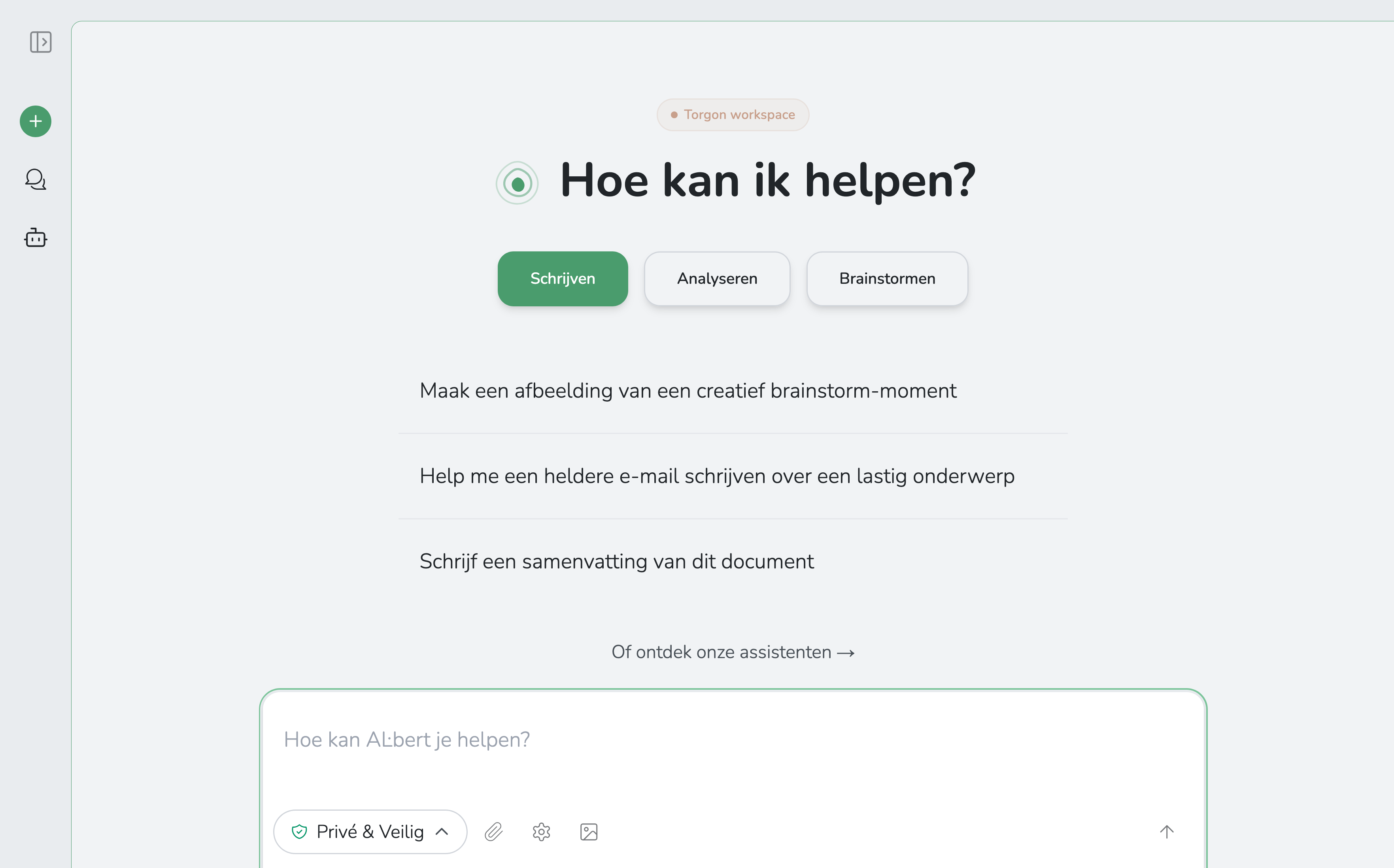
Albert gives your team the productivity of modern AI, with one key difference: all data stays in the Netherlands, under Dutch jurisdiction. No Cloud Act, no Microsoft, no American backdoor.
Why Albert
It's the most common story in public organizations right now.
Microsoft Copilot has been rolled out, it works, it saves time — but something gnaws.
For research agencies, safety regions, tax offices — and any organization working with data that cannot leave the country. Fully Dutch-owned, Dutch jurisdiction, infrastructure in Groningen.
Features
Powerful AI tools for business workflows, fully running on European infrastructure.
AI-powered tools to search, extract, and automatically transform documents.
Create specialized AI assistants with custom prompts, model settings, and reference files. Share with your team.
Generate images from text descriptions for presentations, documentation, and more.
Upload PDFs, images, and documents. Albert analyzes and answers questions about your content.
Speed
Albert streams answers directly to your screen. You start reading while the analysis is still coming in — as fast as you read. No loading screen, no stuttering. You stay in your flow.
Live demo — this is the actual speed.
Certified security in Groningen
All data stays in the Netherlands
Built according to European privacy rules
Built in Groningen, no foreign investors
For whom
Research agencies, municipalities, safety regions, public health services, collaborations, local media. Teams of 10 to 500 employees where sensitive data and AI productivity are both essential.
Packages on request. Free pilot for eligible organizations.
Frequently asked questions
For the workflows our customers use Albert for — document analysis, summaries, writing, research — the difference in quality is negligible. We run modern open-weight models on our own infrastructure, not a stripped-down European version. You notice the difference in privacy, not in output.
The US Cloud Act (2018) gives US authorities the power to request data from American companies, regardless of where that data is physically located. An EU region of Microsoft Azure or Google Cloud doesn't change that legally — the company itself falls under American jurisdiction. Albert doesn't run at an American company; we are 100% Dutch-owned with Dutch infrastructure. The Cloud Act doesn't apply to us.
For most organizations, the answer is: for the work you can't do in Copilot. Interview transcripts, draft reports, case files, policy documents with personal data — anything that poses a risk under the Cloud Act. Some customers use both: Copilot for general productivity, Albert for everything sensitive. Others replace Copilot entirely.
On your own device, in your browser. Albert processes your question on our infrastructure in Groningen to provide an answer, but the conversation history is not stored on our servers — it lives locally with you. No server-side database of conversations, nothing to leak, nothing to subpoena.
Yes. Our current customer base is in research and social domain, but the platform is built for any organization where sensitive data and AI productivity intersect. For healthcare, we're working towards NEN 7510 certification.
Albert runs on a combination of modern open-weight models, hosted on our own infrastructure in Groningen. We're transparent about which models we deploy and update that when better ones come out — without affecting where your data is stored. For specific details about models and versions, ask during the demo.
Yes, standard. Our DPA is drafted based on the model clauses of the Dutch Data Protection Authority and is immediately available upon contract signing — suitable for inclusion in your procurement file. For ethics committee processes and organizations with additional requirements, we adapt the DPA as needed.
Your data is yours. Upon termination, you export all conversations, assistants, and files in a standard format. After that, we delete everything within 30 days — confirmed in a deletion statement. No lock-in, no barriers.
A pilot typically runs within one week — accounts created, SSO configured, brief training for the first users. For larger rollouts with additional compliance requirements, we estimate 2-4 weeks. We've done this process multiple times now and know where the bumps are.
Free pilot for public and social organizations. Operational within one week.
Start a pilot